# The Madhava-Leibniz series for pi, with Madhava's correction terms, in Python
> The Madhava-Leibniz series for pi from the Sanskrit verses: a word-by-word translation, Madhava's end corrections, tested Python and a convergence benchmark.
Published 2026-11-02, 15 min read, Ancient algorithms
Source: https://prasad.tech/blog/madhava-leibniz-series-pi-correction-terms/
---
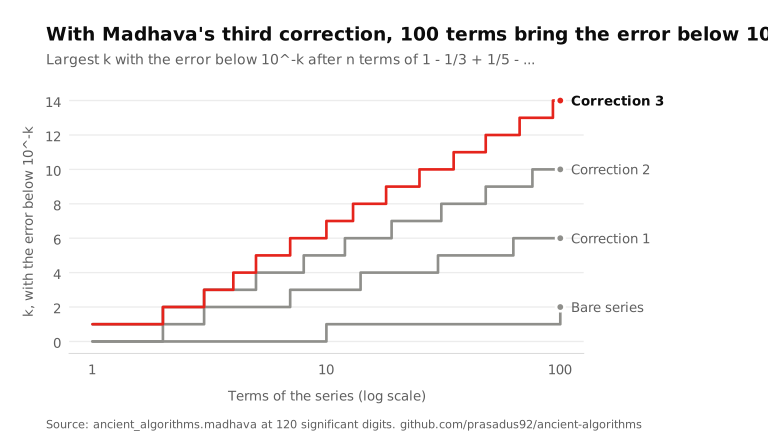
Sum 100 terms of `1 - 1/3 + 1/5 - 1/7 + ...`, multiply by 4, and your value of pi is still off by about 0.01. Kerala astronomers had a fix. Sanskrit texts written there in the 16th century credit Madhava (Mādhava) of Sangamagrama, who lived c. 1340 to 1425, with this series, now called the Madhava-Leibniz series, and with 3 end corrections that estimate the part you leave out. With the third correction, the same 100 terms bring the error below 10^-14.
In Europe, James Gregory found the arctangent series in 1671 and Gottfried Leibniz the pi/4 case in 1673. I took the Sanskrit verses that state the series and the corrections, translated them word by word, worked an example, and coded all of it in Python with tests. The code is on [GitHub](https://github.com/prasadus92/ancient-algorithms), and this is post 2 of [Ancient algorithms, implemented](/ancient-algorithms/), after [the kuttaka](/blog/kuttaka-method-extended-euclidean-algorithm/).
## What the Madhava-Leibniz series computes
Indian astronomers needed the circumference of a circle from its diameter, to turn arcs into sines and back. Aryabhata (499 CE) used `62832/20000 = 3.1416`. Bhaskara II's Lilavati (1150) gives `3927/1250`, the same value. Kerala astronomers wanted more digits:
- Verses quoted in the *Yuktidipika* (chapter 2, verse 298) give `104348/33215`, which is pi to 9 decimal places. Whish (1834) printed them as part of the *Tantrasangraha*.
- The *Sadratnamala* of Sankaravarman (1819) gives pi rounded to 17 decimal places, written in the [katapayadi](/blog/katapayadi-system-decoder/) letter code.
An infinite series can give as many digits as you are willing to compute. The series here is
$$\frac{C}{4d} = 1 - \frac{1}{3} + \frac{1}{5} - \frac{1}{7} + \cdots$$
where `C` is the circumference and `d` the diameter. The texts state it for the circumference, so every term carries a factor `4d`.
The series converges slowly. The error after `n` terms is close to `1/n`, so each new correct digit costs 10 times as many terms. 10,000 terms bring the error below 10^-4, and a million terms below 10^-6. Madhava's end corrections stop early and estimate everything skipped with 1 fraction.
## Who was Madhava of Sangamagrama, and who wrote the series down?
No surviving work by Madhava contains the series or the corrections. The works that survive under his name, such as the *Venvaroha* (with an epoch in 1400 CE) and the *Sphutacandrapti*, do not state them. The series reaches us through later Kerala authors:
- **Nilakantha Somayaji** (1444 to 1545), author of the *Tantrasangraha*, completed in 1500. K. V. Sarma, who edited it in 1977, dates it from chronograms in the text.
- **Shankara Variyar** (c. 1500 to 1560), who wrote the *Yuktidipika*, a commentary in Sanskrit verse on the *Tantrasangraha*, and the *Kriyakramakari*, a prose commentary on Bhaskara II's *Lilavati*. Sarma dates his works to between 1529 and 1556, from dates written in them.
- **Jyeshthadeva** (c. 1500 to 1610 in Sarma's estimate), who wrote the *Yuktibhasa* in Malayalam prose. It derives the series and argues for the first 2 corrections.
Here is what each text says about authorship, as far as I could check:
- **The *Yuktidipika*** (chapter 2, verses 271 to 274 and 295 to 296) quotes the series and corrections in quotation marks, followed by *iti*, the Sanskrit marker for "end of quotation". In Sarma's edition no name stands next to these verses.
- **The *Kriyakramakari*** introduces the same rule as "an easier way to get the circumference", mentioned by Madhava. That is Kim Plofker's translation (2009), as quoted on Wikipedia; I have not seen the book or the Sanskrit.[^plofker]
- **Modern accounts.** Krishnachandran (2024) states that all 3 corrections are "attributed to Mādhava" in Kerala texts.
Madhava's dates, c. 1340 to 1425, are an inference. They rest on his pupil Parameshvara (c. 1360 to 1455), on the 1400 CE epoch of the *Venvaroha*, and on Sarma's study of the Kerala astronomers. Charles Whish, an East India Company official in Madras, first described these series to European readers in a paper read in December 1832 and published in 1834.
## The verses
The verses below are from the *Yuktidipika*, chapter 2, verses 271 to 274, in K. V. Sarma's 1977 edition, page 101. I checked the text against the printed page. Whish (1834) identified the meter as *giti*.
*vyāse vāridhinihate rūpahṛte vyāsasāgarābhihate |*
*triśarādiviṣamasaṃkhyābhaktam ṛṇaṃ svaṃ pṛthak kramāt kuryāt || 271 ||**yatsaṃkhyayātra haraṇe kṛte nivṛttā hṛtis tu jāmitayā |*
*tasyā ūrdhvagatā yā samasaṃkhyā taddalaṃ guṇo 'nte syāt || 272 ||**tadvargo rūpayuto hāro vyāsābdhighātataḥ prāgvat |*
*tābhyām āptaṃ svam ṛṇe kṛte dhane kṣepa eva karaṇīyaḥ || 273 ||**labdhaḥ paridhiḥ sūkṣmo bahukṛtvo haraṇato 'tisūkṣmaḥ syāt || 274 ||*
### Word by word
The numbers are written as words, a system called *bhutasankhya*. *Varidhi*, *sagara* and *abdhi* all mean "ocean" and stand for 4, the traditional count of oceans. *Rupa*, "form", stands for 1. *Tri* is 3, and *shara*, "arrow", stands for 5.
| Sanskrit | Parts | Meaning |
|---|---|---|
| *vyāse vāridhinihate* | vyāsa + vāridhi + nihata | the diameter multiplied by 4 (oceans) |
| *rūpahṛte* | rūpa + hṛta | divided by 1 |
| *vyāsasāgarābhihate* | vyāsa + sāgara + abhihata | the diameter multiplied by 4 (oceans) |
| *triśarādiviṣamasaṃkhyābhaktam* | tri + śara + ādi + viṣama + saṃkhyā + bhakta | divided by the odd numbers 3, 5 and so on |
| *ṛṇaṃ svaṃ* | ṛṇa, sva | negative, positive |
| *pṛthak kramāt kuryāt* | | one should apply separately, in order |
| *yatsaṃkhyayā atra haraṇe kṛte* | yad + saṃkhyā, haraṇa, kṛta | when division has been done by whichever number |
| *nivṛttā hṛtiḥ tu jāmitayā* | nivṛtta, hṛti, jāmitā | the dividing stops, from weariness |
| *tasyā ūrdhvagatā yā samasaṃkhyā* | ūrdhva + gata, sama + saṃkhyā | the even number that comes after it |
| *taddalaṃ guṇo 'nte syāt* | tad + dala, guṇa, anta | its half is the multiplier at the end |
| *tadvargo rūpayuto hāraḥ* | tad + varga, rūpa + yuta, hāra | its square plus 1 is the divisor |
| *vyāsābdhighātataḥ prāgvat* | vyāsa + abdhi + ghāta | of the diameter times 4 (ocean), as before |
| *tābhyām āptam* | | what is obtained from those 2 |
| *svam ṛṇe kṛte* | sva, ṛṇa, kṛta | is positive when (the last term) was made negative |
| *dhane kṣepa eva karaṇīyaḥ* | dhana, kṣepa, karaṇīya | when positive, ... is to be made (see below) |
| *labdhaḥ paridhiḥ sūkṣmaḥ* | labdha, paridhi, sūkṣma | the circumference obtained is accurate |
| *bahukṛtvo haraṇataḥ atisūkṣmaḥ syāt* | bahu + kṛtvas, haraṇa, ati + sūkṣma | from dividing many times, it becomes very accurate |
### My translation
> **271.** Multiply the diameter by 4 and divide by 1. Multiply the diameter by 4, divide separately by the odd numbers 3, 5 and so on, and apply the results in turn as negative and positive.
>
> **272.** When you stop dividing, out of weariness, at some number, take the even number that comes after it. Half of that is the multiplier for the end.
>
> **273.** The square of that even number, plus 1, is the divisor of the diameter times 4, as before. What these 2 give is added when the last term was subtracted, and subtracted when it was added.
>
> **274.** The circumference obtained is accurate. From dividing many times, it becomes very accurate.
The last half of verse 273 reads *dhane kṣepa eva karaṇīyaḥ* in Sarma's edition, and *kṣepa* normally means "addition". The sense, and every translation I have seen, needs a subtraction there. Whish printed this half-line in 1834 as *śodhanañ ca karaṇīyam*, "and a subtraction is to be made", which fits. My translation follows the sense.
Whish's 1834 translation, which is in the public domain, reads:
> Multiply the diameter by 4, and from it subtract and add alternately the quotients obtained by dividing four times the diameter by the odd numbers 3, 5, 7, 9, 11, &c, do thus to the extent required; and having fixed a limit, take half the even number next less than the last odd divisor for a multiplier, and its square plus one for a divisor. Multiply four times the diameter by the multiplier, and divide the product by the divisor, and add it or subtract it, according to the sign of the last quote in the series, from the sum of the series thus the circumference of the given diameter will be obtained very correctly.
>
> C. M. Whish, *Transactions of the Royal Asiatic Society* 3 (1834), p. 512
Whish's "next less than" does not match the verse, which says the even number "that has gone above", the next one up. With the even number below, the example in the next section comes out at 3.094 instead of 3.14166. In his translation of the third correction, Whish uses the even number above.
The third correction is in verses 295 and 296, on page 103 of Sarma's edition:
एभ्यः सूक्ष्मतरोऽन्यो विलिख्यते कश्चनापि संस्कारः । अन्ते समसंख्यादलवर्गः सैको गुणः स एव पुनः ॥ २९५ ॥ युगगुणितो रूपयुतः समसंख्यादलहतो भवेद् हारः । त्रिशरादिविषमसंख्याहरणात् परमेतदेव वा कार्यम् ॥ २९६ ॥
*ebhyaḥ sūkṣmataro 'nyo vilikhyate kaścanāpi saṃskāraḥ |*
*ante samasaṃkhyādalavargaḥ saiko guṇaḥ sa eva punaḥ || 295 ||*
*yugaguṇito rūpayutaḥ samasaṃkhyādalahato bhaved dhāraḥ |*
*triśarādiviṣamasaṃkhyāharaṇāt param etad eva vā kāryam || 296 ||*
> **295 to 296.** Another correction, finer than these, is now written. At the end, the square of half the even number, plus 1, is the multiplier. That same number times 4 (*yuga*, the 4 ages), plus 1, times half the even number, is the divisor. After dividing by the odd numbers 3, 5 and so on, apply this instead.
## What the verses leave open
1. **Who wrote them.** The *Yuktidipika* quotes both sets of verses without naming an author. The credit to Madhava comes from the *Kriyakramakari* and from the later tradition.
2. **The first correction.** No verse states `1/(4n)` by itself. The *Yuktibhasa* reaches it as a first guess on the way to the second, which is why it counts as a correction at all.
3. **Where the corrections come from.** The *Yuktibhasa* argues for the first 2. No surviving text explains the third. Historians have proposed reconstructions, which I list under "What is debated".
4. **The sign.** Verse 273 gives the rule for adding or subtracting, with the textual problem above. The code follows the sense: the correction always has the sign opposite to the last term used.
## Working an example
Take a diameter of 1 and stop after 5 terms, so the last divisor is 9.
**Step 1. The series.** `4 - 4/3 + 4/5 - 4/7 + 4/9 = 1052/315`, which is 3.33968, off by 0.198.
**Step 2. The multiplier and divisor.** The even number after 9 is 10. Half of it, 5, is the multiplier. The even number's square plus 1, `10^2 + 1 = 101`, is the divisor.
**Step 3. The correction.** `4 × 5 / 101 = 20/101`, which is 0.19802.
**Step 4. The sign.** The last term, `4/9`, was added, so subtract: `1052/315 - 20/101 = 99952/31815`, which is 3.14166.
Pi is 3.14159, so 5 terms and 1 fraction bring the error down to 0.00007, below 10^-4. The bare series needs about 10,000 terms for that.
In terms of `n`, the number of terms, the multiplier is `n` and the divisor is `4n^2 + 1`. Divide by `4d` to get the 3 corrections for `pi/4`:
| Correction | After `n` terms | Source |
|---|---|---|
| 1 | `1/(4n)` | *Yuktibhasa*, as a first step |
| 2 | `n/(4n^2 + 1)` | *Yuktidipika* 2.271 to 274 |
| 3 | `(n^2 + 1)/(4n^3 + 5n)` | *Yuktidipika* 2.295 to 296 |
## Why the corrections work
Call `f(p)` the exact correction you would add after stopping at the odd divisor `p`. Stop at `p - 2` instead and the correction must make up for the term `1/p` as well. So the true correction satisfies
$$f(p-2) + f(p) = \frac{1}{p}$$
The *Yuktibhasa* argues from this condition. If `f` were the same at `p - 2` and `p`, each would be `1/(2p)`. But a single rule has to apply at every stopping point, so try the value at the midpoint, the even number `p + 1`:
$$f_1(p) = \frac{1}{2(p+1)} = \frac{1}{4n}$$
Put `f_1` into the condition and the 2 sides miss by `1/(p^3 - p)`, which the texts call the *sthaulya*, the "grossness". Choosing the denominator to make that miss smaller gives the second correction, whose *sthaulya* is `4/(p^5 + 4p)`. Ramasubramanian writes the 3 denominators as
$$2(p+1), \qquad 2(p+1) + \frac{4}{2(p+1)}, \qquad 2(p+1) + \cfrac{4}{2(p+1) + \cfrac{16}{2(p+1)}}$$
Each is the next step of a continued fraction, and with `p = 2n - 1` they turn into the 3 formulas in the table above. Each step makes the error fall faster as `n` grows. The tests check that doubling `n` divides the error by about 8, 32 and 128 for corrections 1, 2 and 3, so the errors fall as `n^-3`, `n^-5` and `n^-7`.
## The Python
This is the rule from the verses, with exact fractions:
```python
from fractions import Fraction
def madhava_circumference(diameter: int, terms: int, correction: int = 2) -> Fraction:
"""4d(1 - 1/3 + 1/5 - ...) to `terms` terms, plus one of Madhava's end corrections."""
total = Fraction(0)
for k in range(terms):
term = Fraction(4 * diameter, 2 * k + 1)
total += term if k % 2 == 0 else -term
n = terms
tail = {
0: Fraction(0),
1: Fraction(1, 4 * n),
2: Fraction(n, 4 * n * n + 1),
3: Fraction(n * n + 1, 4 * n**3 + 5 * n),
}[correction]
sign = 1 if n % 2 == 0 else -1 # subtract after an added last term
return total + sign * 4 * diameter * tail
print(float(madhava_circumference(1, 5, 0))) # 3.33968253968254
print(float(madhava_circumference(1, 5))) # 3.1416627377023416
print(float(madhava_circumference(1, 20, 3))) # 3.1415926540198638
```
The [repo version](https://github.com/prasadus92/ancient-algorithms/blob/main/src/ancient_algorithms/madhava.py) works in `decimal.Decimal` at a precision you choose, so it can measure the error against a 100-place reference value. It also has the faster series `pi = sqrt(12) × (1 - 1/(3 × 3) + 1/(5 × 3^2) - ...)`, which the *Yuktidipika* also states (chapter 2, verse 212), and John Machin's 1706 formula for comparison. The tests check:
- each correction beats the one before it at 10, 20, 40 and 80 terms;
- doubling `n` divides the error by `2^3`, `2^5` and `2^7`, within half a power of 2;
- 50 terms with the third correction give an error below 10^-12;
- Machin's formula with 41 terms reproduces pi to the 60 significant digits the module works at.
## Against the modern methods
Here is the benchmark from the repo, `benchmarks/madhava_convergence.py`, computed at 120 significant digits. Each cell is the largest `k` with the error below 10-k. That can be 1 more than the number of decimals that agree: 100 terms of the bare series give 3.1316, an error of 0.0099998, so the cell says 2 while only 1 decimal agrees.
| Terms | 1 | 2 | 5 | 10 | 20 | 50 | 100 |
|---|---|---|---|---|---|---|---|
| Bare series | 0 | 0 | 0 | 1 | 1 | 1 | 2 |
| + correction 1 | 0 | 1 | 2 | 3 | 4 | 5 | 6 |
| + correction 2 | 1 | 2 | 4 | 5 | 7 | 9 | 10 |
| + correction 3 | 1 | 2 | 5 | 7 | 9 | 12 | 14 |
| `sqrt(12)` series | 0 | 1 | 2 | 5 | 10 | 25 | 49 |
| Machin (1706) | 1 | 3 | 7 | 14 | 29 | 71 | 100 |
The 100 in the Machin column is the precision of the reference value, so it is a floor.
Machin's formula, `pi/4 = 4 arctan(1/5) - arctan(1/239)`, uses the same arctangent series at small arguments, so each term shrinks by a factor of 25 or more.
The Kerala texts also contain faster series. Whish printed one in 1834, `C = 16d (1/(1^5 + 4) - 1/(3^5 + 12) + 1/(5^5 + 20) - ...)`, which is in the *Yuktidipika* at chapter 2, verses 287 to 288. Krishnachandran (2024) shows how series of this kind follow from the correction terms.
## Parallels and lineage
The connections I can support from sources:
- **James Gregory, 1671.** Gregory found the arctangent series in 1671, by what we now call Taylor series (Roy 1990).
- **Gottfried Wilhelm Leibniz, 1673 to 1676.** Roy (1990) dates Leibniz's discovery of the pi/4 series to 1673, by a transformation of areas. Leibniz sent it to Christiaan Huygens, and Isaac Newton praised it in a letter to Henry Oldenburg of 24 October 1676.
- **Kerala, 14th to 16th century.** The same series, with the corrections, in the texts above. The same texts give series for sine and cosine, which Ramasubramanian (2022) lists among the Kerala results.
## What is debated
- **Transmission to Europe.** Unproven. I found no published document that shows the series passing from Kerala to Gregory or Leibniz, and Roy (1990) treats the 3 discoveries as independent. C. K. Raju (*Cultural Foundations of Mathematics*, 2007) argues that the calculus passed from India to Europe in the 16th century. I have not read the book, so I note the claim without assessing it.
- **Who found the series.** Roy (1990) wrote that the Indian author was "usually ascribed" to be Nilakantha, and that his identity was "not definitely known". Later work, using the *Kriyakramakari*, settles on Madhava. No text in Madhava's own hand survives to confirm it.
- **How the third correction was found.** The texts give no rationale for it. Hayashi, Kusuba and Yano (1990) proposed that all 3 corrections came from a known value of pi, such as `355/113`, worked through a Euclidean-style division. Krishnachandran (2024) summarizes this and shows the same derivation works from Aryabhata's `62832/20000`.
- **Madhava's home.** Sarma and others place Sangamagrama at Irinjalakuda. Krishnachandran (2024) argues for Kudallur, on the Nila river, whose Malayalam name means "confluence village".
- **The reading of verse 273.** The *kṣepa* problem above.
## Key takeaways
- `pi/4 = 1 - 1/3 + 1/5 - ...` is stated in Sanskrit verse in Shankara Variyar's *Yuktidipika* (16th century), which quotes it without a name. The *Kriyakramakari* credits it to Madhava (c. 1340 to 1425). None of Madhava's surviving works contains it.
- The verses add an end correction: after stopping, add or subtract `4d × n/(4n^2 + 1)`. A second verse gives a finer one, `4d × (n^2 + 1)/(4n^3 + 5n)`.
- With 20 terms, the bare series is off by 0.05 and the third correction by less than 10^-9.
- Gregory (1671) and Leibniz (1673) found the series in Europe. No documented route links them to Kerala.
- The code, tests and benchmark are in [ancient-algorithms](https://github.com/prasadus92/ancient-algorithms). Next in the series: [Pingala's enumeration of meters](/blog/pingala-binary-meru-prastara/).
## Sources
- Nilakantha, *Tantrasangraha*, with the *Yuktidipika* and *Laghuvivrti* of Shankara, edited by K. V. Sarma. Vishveshvaranand Vedic Research Institute, Hoshiarpur, 1977. Chapter 2, verses 271 to 274 (p. 101) and 295 to 296 (p. 103). [Scan on archive.org](https://archive.org/details/tantrasangrahanilakanthasomyajiyuktidipikalaghuvrittiofsankarasarmak.v.vishveshv).
- C. M. Whish, ["On the Hindú quadrature of the circle"](https://archive.org/details/jstor-25581775). *Transactions of the Royal Asiatic Society of Great Britain and Ireland* 3 (1834), pp. 509 to 523.
- K. Plofker, *Mathematics in India*. Princeton University Press, 2009. Not read; quoted through Wikipedia's "Kriyakramakari" article.
- R. Roy, "The discovery of the series formula for pi by Leibniz, Gregory and Nilakantha". *Mathematics Magazine* 63(5), 1990, pp. 291 to 306.
- V. N. Krishnachandran, ["On Mādhava and his correction terms for the Mādhava-Leibniz series for π"](https://arxiv.org/abs/2405.11134), arXiv 2405.11134, 2024.
- K. Ramasubramanian, ["The history and historiography of the discovery of calculus in India"](https://www.mathunion.org/fileadmin/IMU/ICM2022/Presentation-slides/218-Krishnamurthi%20Ramasubramanian.pdf), ICM 2022 lecture slides.
- T. Hayashi, T. Kusuba and M. Yano, "The correction of the Mādhava series for the circumference of a circle". *Centaurus* 33, 1990, pp. 149 to 174. Not read; summarized from Krishnachandran (2024).
[^plofker]: I have this attribution only through Plofker's translation as quoted on Wikipedia. I have not seen Plofker's book or Sarma's 1975 edition of the *Kriyakramakari*.
---
## Common questions
**What is the Madhava-Leibniz series?**
It is the infinite series pi/4 = 1 - 1/3 + 1/5 - 1/7 + ..., the arctangent series at x = 1. Sanskrit texts from 16th-century Kerala state it and credit it to Madhava of Sangamagrama (c. 1340 to 1425). In Europe, James Gregory found the arctangent series in 1671 and Gottfried Leibniz found the pi/4 series in 1673.
**What are Madhava's correction terms?**
They estimate the tail of the series after you stop. If the last term used has denominator 2n - 1, the 3 corrections for pi/4 are 1/(4n), n/(4n^2 + 1) and (n^2 + 1)/(4n^3 + 5n). The Yuktidipika states the second and third in verse. With 20 terms they bring the error below 10^-4, 10^-7 and 10^-9, against 10^-1 for the bare series.
**Who is the father of mathematics in Kerala?**
Madhava of Sangamagrama. Modern writers call him the founder of the Kerala school of astronomy and mathematics, for example V. N. Krishnachandran (2024), and K. Ramasubramanian's ICM 2022 lecture calls him its pioneer. Later Kerala authors refer back to him: K. V. Sarma (1977) notes that Nilakantha (born 1444) quotes Madhava often, and Shankara Variyar's Kriyakramakari credits the pi series to him.
**Did Leibniz copy the series from India?**
No published document I found shows the series traveling from Kerala to Europe. Transmission is unproven, and historians still debate it.